
Sacral nerve neuromodulation
A bladder pacemaker to regain control
Sacral neuromodulation (S3) can help with urgency, urge incontinence, or urinary retention. Initial testing, implantation, and follow-up: Dr. Peyrat, urologist in Paris.
When should neuromodulation be considered?
Sacral nerve neuromodulation is an innovative technique used to treat certain urinary or pelvic disorders resistant to conventional treatments . It allows for the regulation of nerve activity responsible for controlling the bladder, rectum, and perineum.
Neuromodulation can be offered in the following situations:
Overactive bladder (urgent urges, leakage, frequent urination),
Functional urinary retention (inability to urinate without a mechanical cause),
Chronic pelvic pain or painful bladder syndrome,
Some cases of severe constipation or anal incontinence , after multidisciplinary consultation.
It is indicated when first-line treatments (medications, perineal rehabilitation, botulinum toxin injections) are ineffective or poorly tolerated.

Origin of the disorders in question
Neuromodulation addresses functional pathologies, where the dysfunction lies in the communication between the brain, spinal cord and pelvic organs .
These disorders may be related to:
- an underlying neurological condition (multiple sclerosis, spinal cord injury, spina bifida),
- or be idiopathic (without a known cause) but resistant to conventional treatments.
Treatment objective
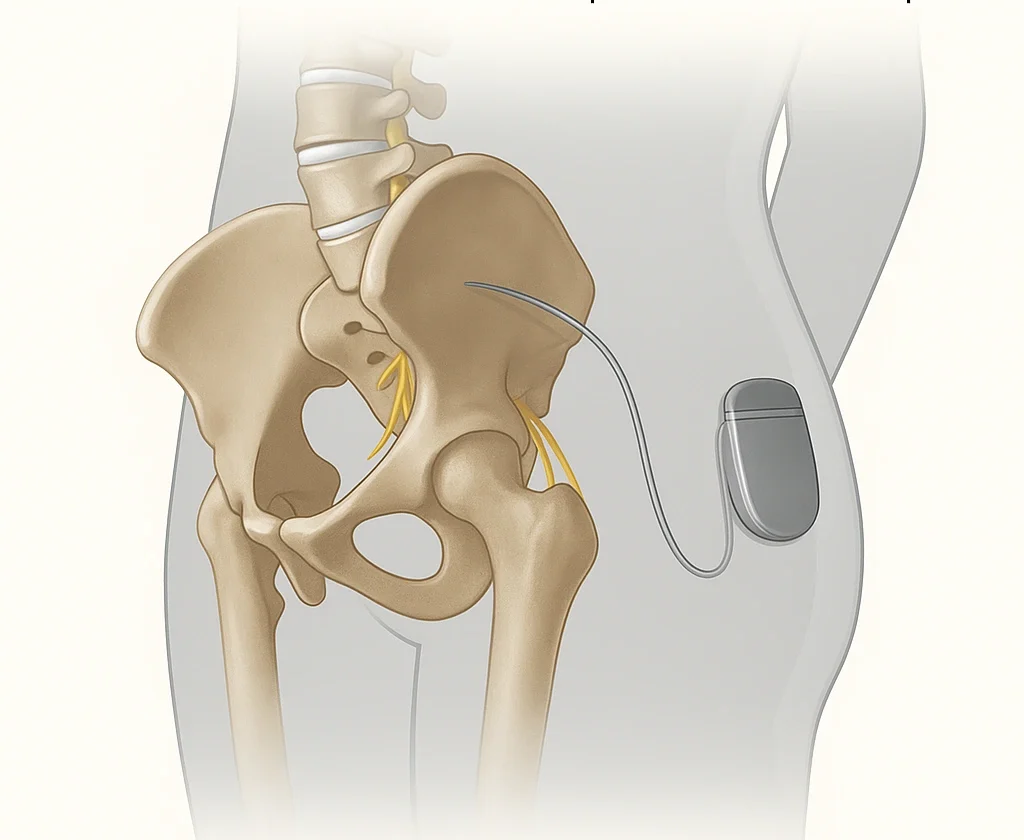
The goal of neuromodulation is to “retrain” the nervous system by gently stimulating the sacral nerve roots (primarily S3) with low-frequency electrical impulses. This technique can: reduce overactive bladder, restore a normal sensation of urinary urge, improve or trigger bladder emptying, and relieve chronic pelvic pain.
Process of treatment
Step 1: Test Phase (or Evaluation Phase) Performed on an outpatient basis, under local or light anesthesia. Implantation of a thin electrode near the sacral nerve root (often S3). Connection to an external neurostimulator for 1 to 3 weeks. Objective: to evaluate the effectiveness on urinary and pelvic symptoms. The patient keeps a voiding diary to record improvements. If the test phase shows an improvement of ≥ 50%, permanent implantation is performed. Step 2: Neurostimulator Implantation Performed under light general anesthesia. The stimulator (the size of a USB key) is implanted under the skin, in the upper buttock. Permanent connection to the test phase electrode. The device is programmable and adjustable during a consultation.
Post-operative follow-up
Programming and adjustment of the pacemaker according to individual needs. Regular follow-up by Dr. Laurence Peyrat and/or a specialized nurse. Replacement of the device every 5 to 10 years depending on the model used.
Expected results
High success rate: improvement in 70 to 80% of selected cases. Long-lasting and well-tolerated effects. Significant improvement in quality of life, particularly for patients with complex or resistant urinary disorders.
Possible side effects
Transient pain at the implantation site, electrode displacement (rare), discomfort related to the device (especially in thin individuals), and the need for adjustment or reprogramming in case of loss of effectiveness. Stimulation can be stopped at any time without permanent consequences.
Why consult Dr. Laurence Peyrat?
My review in video
Let me introduce you to the principle of sacral neuromodulation. It is a minimally invasive treatment that gently stimulates the sacral nerves to improve urinary control and relieve chronic pelvic disorders .
Area of expertise
Sacral nerve neuromodulation
 My review in videoLaurence Peyrat
My review in video
FAQ – Frequently Asked Questions
What is sacral neuromodulation?
It’s a kind of “bladder pacemaker”: a thin electrode placed in contact with a sacral nerve root delivers a gentle and continuous stimulation that rebalances nerve exchanges between the bladder and the brain.
Who is this treatment intended for?
It is indicated for patients suffering from drug-resistant overactive bladder, chronic non-obstructive urinary retention, and in some cases, associated anorectal disorders. It is offered after first-line treatments have failed.
How do we know if neuromodulation will work?
Following a trial period of a few weeks, the electrode is placed and connected to an external device. If symptoms improve by at least 50%, the permanent stimulator is implanted under the skin in a second, brief procedure.
Does the implant change daily life?
Very little. The discreet device is rechargeable or controlled by remote. Most activities, including sports, remain possible, and MRIs can be performed with recent devices under certain conditions. The battery lasts for several years.
Dr Laurence Peyrat's expertise
Chirurgienne Urologue à Paris

Sacral nerve neuromodulation: there are solutions.