
Suburethral sling
The standard treatment for stress incontinence
Suburethral sling: an effective option for stress urinary incontinence. Indications, procedure, post-operative care, and precautions. Dr. Peyrat, urologist in Paris.
When should a suburethral sling be considered?
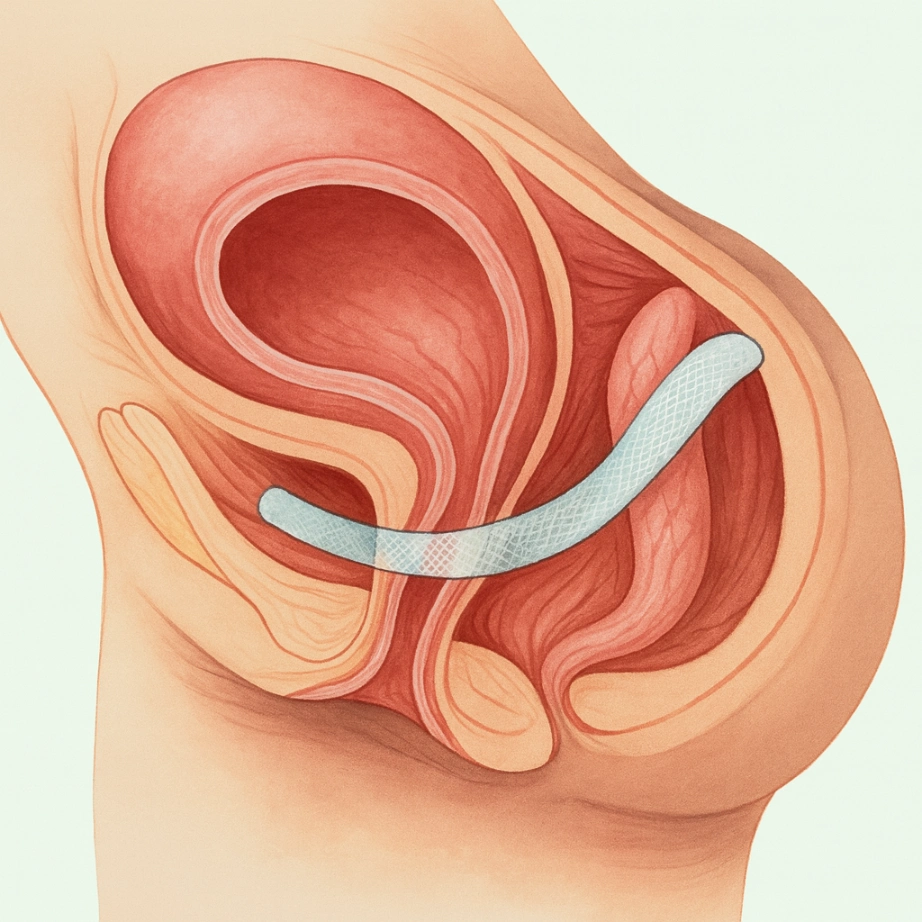
Origins of stress incontinence
Stress urinary incontinence is linked to a failure of the urethral sphincter or a lack of urethral support , often secondary to:
- childbirth,
- pelvic relaxation,
- menopause,
- certain previous pelvic surgeries.
The sling aims to reposition and support the urethra effectively and naturally.

Suburethral sling technique
This is a minimally invasive procedure performed on an outpatient basis, under local or light general anesthesia.
Principle : placement of a synthetic polypropylene strip under the urethra, acting like a “hammock” to support it during exertion and prevent leaks.
Possible approaches
Retropubic route (TVT): the strip passes behind the pubic bone.
Transobturator approach (TOT): the sling passes through the thigh muscles.
The choice depends on the patient’s anatomy, the intensity of the leakage, and surgical history.
Procedure of the intervention
Duration : 30 to 45 minutes
Hospitalization : outpatient (same-day discharge)
Temporary urinary catheterization for a few hours
Activities will gradually resume starting the following day.
Post-operative care
Burning during urination and moderate cramping for a few days
Minor vaginal discharge possible
Relative rest for 1 to 2 weeks
Resumption of sexual relations after 4 to 6 weeks
Post-operative follow-up with Dr. Peyrat to monitor effectiveness and absence of complications
Expected results
Success rate: 85 to 90% improvement or elimination of leaks
Stable results over time in well-selected patients
Rapid recovery and marked improvement in quality of life
Risks and complications (rare)
Temporary difficulty urinating (urinary retention)
Urinary tract infection
Pelvic pain or pain during exertion
Erosion of the sling into the vaginal wall (rare, treatable)
Hematoma or bleeding (rare)
The choice of patient, the prior urodynamic evaluation and the surgical expertise of Dr. Peyrat help to minimize these risks.
Why consult Dr. Laurence Peyrat?
My review in video
The suburethral sling is a minimally invasive procedure used to treat stress urinary incontinence in women.
Area of expertise
Suburethral sling
 My review in videoLaurence Peyrat
My review in video
FAQ – Frequently Asked Questions
Who is the suburethral sling intended for?
For women suffering from stress urinary incontinence—leakage when coughing, laughing, or exercising—that persists despite well-conducted pelvic floor rehabilitation, this is the standard surgical treatment for this type of incontinence.
How does the procedure unfold?
The sling is inserted under the urethra through a small vaginal incision, under anesthesia, most often on an outpatient basis. The procedure takes approximately 20 minutes and the effect is immediate.
What results and what sustainability?
Success rates reach 85 to 90%, maintained for more than 10 years. The vast majority of patients regain a daily life, including sports and intimate activities, without leaks.
What precautions should be taken after installation?
Avoid strenuous activity, lifting heavy objects, baths, and sexual intercourse for approximately 4 weeks. Transient urgency or initial urinary discomfort is possible and usually resolves spontaneously.
Dr Laurence Peyrat's expertise
Chirurgienne Urologue à Paris

Suburethral sling: there are solutions.