
Botox injection into the bladder
Calming overactive bladder resistant to treatment
Dr. Laurence Peyrat offers Botox injections into the bladder in Paris to treat overactive bladder and urinary incontinence.
When should you consider Botox® injections?
Injections of botulinum toxin type A (Botox®) into the bladder are an effective and recognized treatment to relieve certain urinary disorders, particularly in cases of overactive bladder or neurogenic bladder resistant to conventional treatments.
Botox® injections are indicated when the patient suffers from:
Idiopathic overactive bladder (not related to a neurological cause):
urgent need to urinate,
urinary incontinence,
frequent urination day and night,
despite the failure of anticholinergic or beta-3 agonist drugs.
Overactive neurogenic bladder (due to nervous system involvement):
multiple sclerosis,
spinal cord injury,
spina bifida,
with incontinence or chaotic bladder contractions.

Botox® injections
Treatment objective
Botox® works by temporarily blocking the nerve signals responsible for involuntary bladder contractions.
The goal is to:
Reduce urgency and leakage
Increase bladder capacity
Significantly improve urinary quality of life
Avoid the need for more intensive treatments
Procedure of the intervention
Location : in a clinic, often on an outpatient basis
Duration : 10 to 20 minutes
Anesthesia : local (urethral gel), regional or general depending on the patient’s comfort
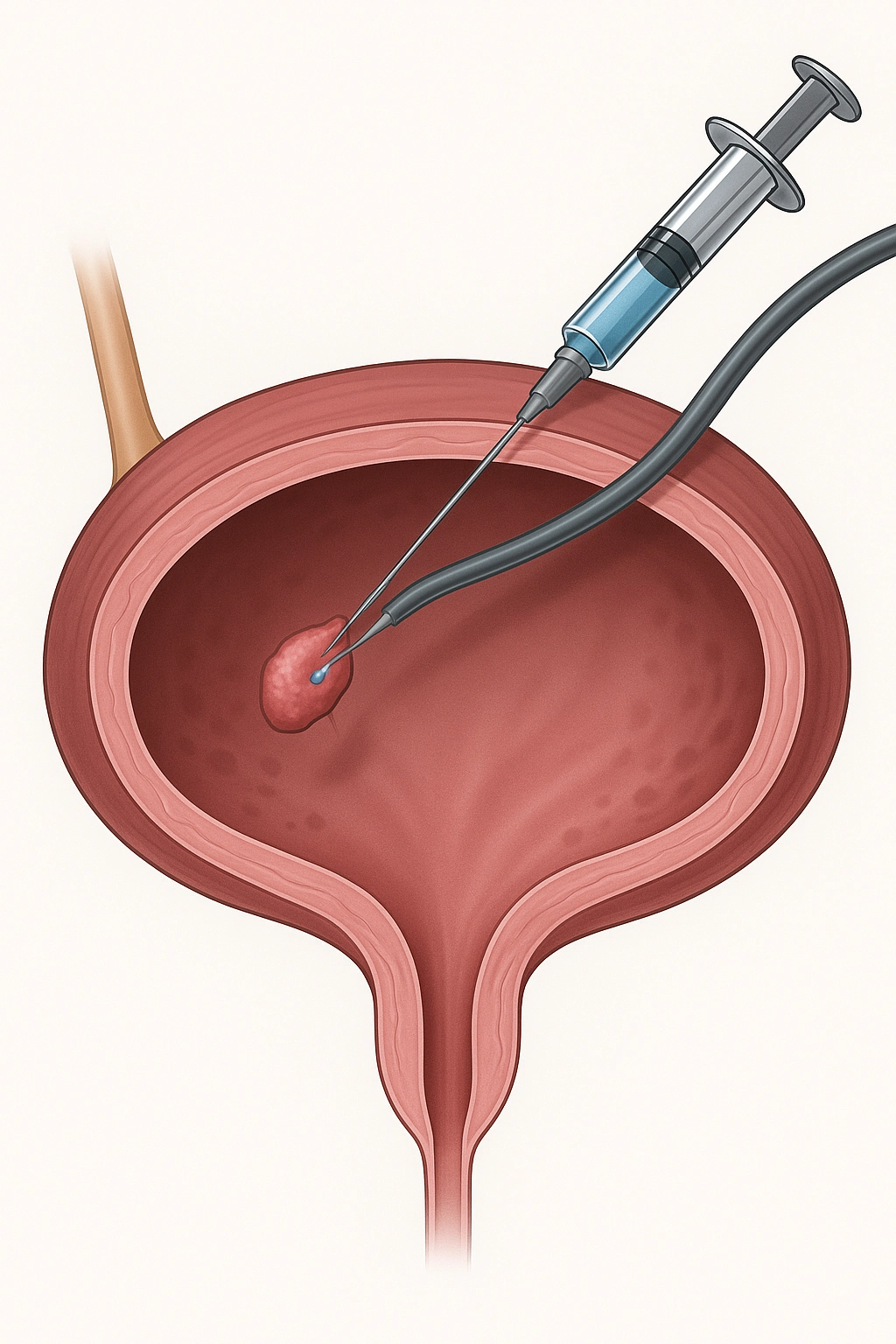
Technical
Performed via the natural route (urethra) using a flexible endoscope
Botulinum toxin injections at several points on the bladder wall using a fine needle
Sequences and results
Expected effects
Visible improvement within 7 to 10 days
Maximum effectiveness at 4 weeks
Duration of action: ~6 to 9 months (sometimes longer)
The treatment can be repeated if the effects wear off.
Benefits
Non-surgical alternative
A minimally invasive procedure, performed on an outpatient basis.
High satisfaction rate (70–80% improvement in good profiles)
Possible side effects
Urinary retention: difficulty urinating that may require temporary self-catheterization (≈10–20% of cases)
Urinary tract infection: antibiotic prophylaxis may be prescribed.
Very rarely: traces of blood in the urine, local discomfort
Contraindications
Active urinary tract infection at the time of the procedure
Uncorrected coagulation disorders
Pregnancy or breastfeeding
History of allergy to botulinum toxin (rare)
Why consult Dr. Laurence Peyrat?
My review in video
In this video, I explain what botulinum toxin injections into the bladder (Botox®) are.
This minimally invasive treatment helps reduce urgency, improve bladder capacity and relieve urinary incontinence.
Area of expertise
Botox injection into the bladder
 My review in videoLaurence Peyrat
My review in video
FAQ – Frequently Asked Questions
How does Botox work on an overactive bladder?
Injected into the bladder muscle, Botox temporarily blocks the involuntary contractions responsible for urgency and leakage. It is indicated for overactive bladder resistant to oral treatments and for certain neurogenic bladders.
How is the injection performed?
The procedure is performed via the natural orifices, under endoscopic guidance, on an outpatient basis, under local or short general anesthesia. Approximately twenty injection points are made in the bladder wall in about ten minutes.
How long does the effect of bladder Botox last?
The effect appears within 1 to 2 weeks and lasts on average 6 to 9 months. Injections are repeated when symptoms reappear, with effectiveness maintained over the course of treatment.
What are the risks?
The main risk is incomplete bladder emptying, which is transient and may require temporary self-catheterization in a minority of patients. This risk, as well as the risk of urinary tract infection, is systematically explained and monitored after the injection.
Dr Laurence Peyrat's expertise
Chirurgienne Urologue à Paris

Botox injection into the bladder: there are solutions.