
Bladder polyp resection
Remove and analyze polyps to protect the bladder
Discover bladder polyp resection with Dr Laurence Peyrat in Paris: a precise endoscopic procedure to treat bladder lesions.
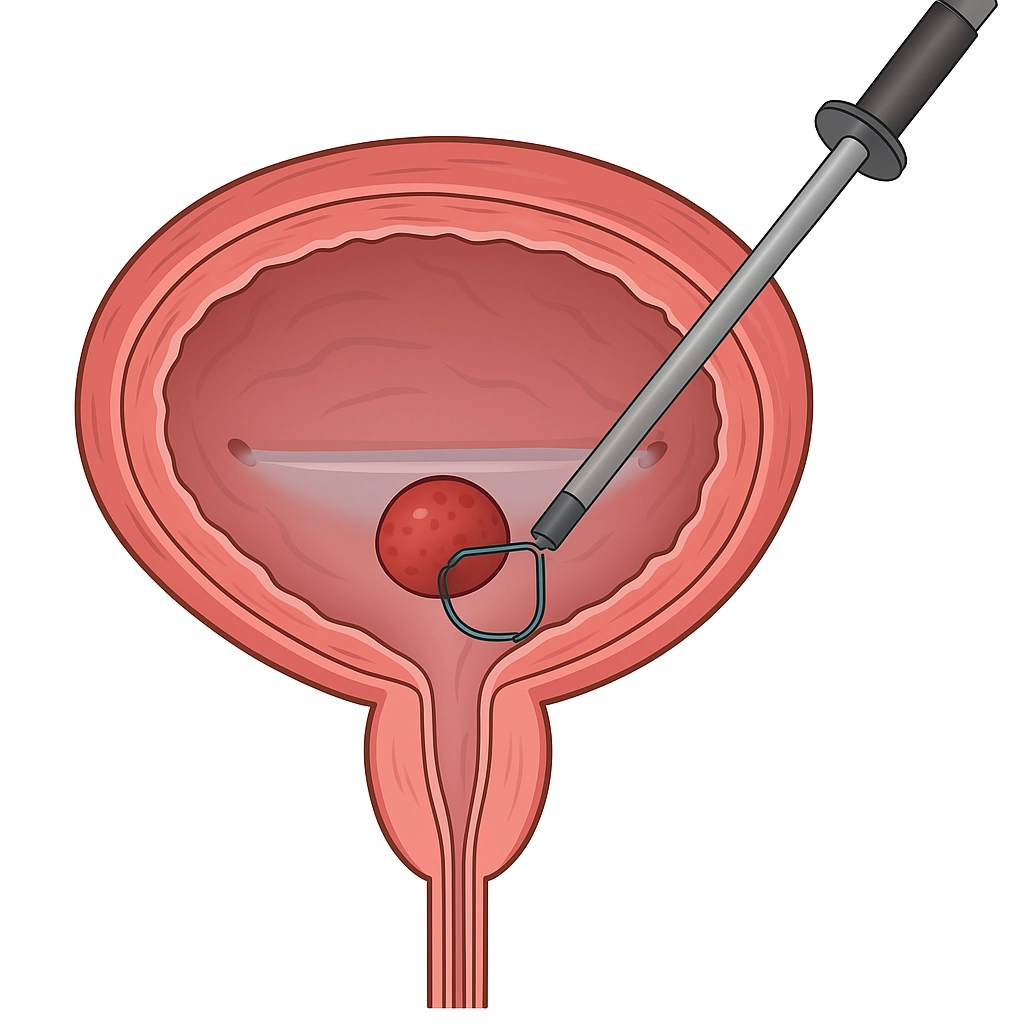
Endoscopic resection of bladder polyps is a common and essential procedure in the management of benign or cancerous bladder lesions . This technique allows for both accurate diagnosis and curative treatment for certain lesions.

What is a bladder polyp?
A polyp is an outgrowth or mass located on the wall of the bladder, often discovered during a cystoscopy performed for urinary symptoms (hematuria, pain, repeated infections) or as part of urological follow-up.
Polyps can be:
Benign (non-cancerous growths),
Precancerous or cancerous (bladder tumors).
When should a resection be considered?
Endoscopic resection is recommended in cases of:
A polyp visible on cystoscopy requires precise diagnosis.
Suspected bladder tumor
Unexplained hematuria,
Monitoring of bladder lesions after treatment.
Objectives of endoscopic resection
Remove the lesion to relieve symptoms and prevent its progression.
To enable an anatomopathological analysis essential for accurate diagnosis and therapeutic guidance.
Avoid, when possible, more invasive surgery.
surgical technique
The procedure was performed via the lower route , using endoscopy (cystoscopy with a resectoscope).
Resection of the lesion using an electric loop or a laser .
Sampling of the lesion, in whole or in part, for analysis.
Performed under general or regional anesthesia .
Short hospitalization, most often on an outpatient basis .
Post-operative care
Transient urinary discomfort.
Blood may be present in the urine for a few days.
Low risk of urinary tract infection (can be prevented with antibiotics).
Gradual resumption of daily activities.
Post-operative monitoring with surveillance cystoscopy .
Results and follow-up
Resection allows for a reliable diagnosis and guides subsequent treatments.
In mild cases, resection is often curative .
In the event of a malignant tumor, regular specialized follow-up is provided by Dr. Laurence Peyrat to prevent recurrences.
Additional treatments may be offered depending on the results: local immunotherapy, surgery or chemotherapy.
Why consult Dr. Laurence Peyrat?
My review in video
This video will help you understand what a bladder polyp is. I’ll explain how it’s diagnosed and the treatment process.
Area of expertise
Bladder polyp resection
 My review in videoLaurence Peyrat
My review in video
FAQ – Frequently Asked Questions
Why is it necessary to remove a bladder polyp?
Any bladder polyp must be removed and analyzed, as it may be a bladder tumor. Histological analysis determines its exact nature, grade, and degree of infiltration, which dictate the subsequent treatment.
How is the resection performed?
Transurethral resection of the bladder (TURB) is performed through the natural urinary tract, under anesthesia, using an endoscopic resectoscope. The polyp is completely removed, including its base. Hospitalization lasts 1 to 2 days, with a temporary urinary catheter in place.
What are the consequences of the intervention?
Pinkish urine and burning during urination are common for a few days. It is recommended to stay well-hydrated and avoid strenuous activity for two weeks. The test results will be explained during your consultation.
Is monitoring necessary afterwards?
Yes, systematically. Bladder tumors tend to recur: a schedule of follow-up cystoscopies is established according to the risk (grade, size, number of polyps). Quitting smoking, the main risk factor, is essential.
Dr Laurence Peyrat's expertise
Chirurgienne Urologue à Paris

Bladder polyp resection: there are solutions.